
|
|
Irish Government
IRISH GOVERNMENT
The Irish Government have been involved in Northern politics since the inception of Northern Ireland and beyond. Many Unionists, especially hardliners, feel that the Irish Government should have absolutely no role in Northern Ireland whatsoever. In fact UK Unionist leader Robert McCartney cited that as his main reason for withdrawing from negotiations that lead to the signing of the Good Friday Agreement. On the other hand Nationalists have felt that the Irish governments involvement is a neccesity.
Ever since partition the Irish government have been involved in one way or another. Initially partition was resented by all Irish leaders and politicans and each general election was paritally fought on the issue of ending partition but gradually that faded although successive Irish governments were still Republican in attitudes towards Northern Ireland.
It wasn't until Sean Lemass became Taoiseach and Captain Terrence O'Neill became NI Prime Minister that relations between the two Irish states improved but North of the border O'Neill was condemned as a traitor by Unionists for just meeting with Lemass even though Sean Lemass made it clear that he was "more interested in the reunification of people than territory". When the troubles began and the Stormont institute was disbanded the Irish governments relations with Britain over Northern Ireland fell to an all time low. Successive British governments failed to agree any role the Irish government should have in Britain until the Sunningdale Agreement was reached between some Ulster Unionists, the SDLP and the two governments. The Irish governments took their cue from John Hume on what to ask for and in the Agreement a Council of Ireland was set up to discuss co-operation on areas of mutual interest.
The term "Council of Ireland" has been a term of much controversy since it got its first mention in the Government of Ireland Act, 1920 and indeed although that council never took place it was the Council of Ireland in the Sunningdale Agreement that Unionists couldn't stand even though , in reality, it had very few powers and the Agreement collapsed.
Relations between the two governments worsened when Margaret Thatcher (British PM) and Charles Haughey (Taoiseach) held office at the same time, both were fiercely patriotic people, Charles Haughey had been involved in the gun running scandal and was in Jack Lynch's government at the time when an Irish invasion of Northern Ireland was contemplated. But when Fine Gael's Garret Fitzgearld took over as Taoiseach relations began to thaw and this led to the signing of the Anglo-Irish Agreement which gave the Irish gaovernment a role in the North, they were to be consulted if any changes were to be made in the North.
Albert Reynolds took over as Irish Premier after Haughey's second reign came to an end, with John Major taking over in Britain, and a new era of Irish involvement began marking the start of a more Unionist friendly approach. Albert Reynolds began to chair talks between John Hume and Gerry Adams which eventually led to the first IRA ceasefire and the first multilateral talks.
In the run up to the signing of the GFA the Irish government was an integral part of negotations in which the Irish people gave up their territorial/constitutional claim to the North in exchange for North-South bodies (Council of Ireland). Today these bodies are working well and there's even talk of expanding them much to the annoyance of the DUP!
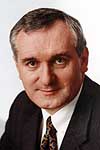 Bertie Ahern
Leader of Ireland's largest party and Prime Minister (Taoiseach) of the Republic of Ireland, Bertie Ahern has made a positive impact on the Northern peace process. Despite being a part of Ireland's "Republican Party" the Taoiseach has always tried to be bi-partisan on Northern Ireland, often laying the blame for various impasses on the IRA and Sinn Fein which has often made him unpopular in the Nationalist community. He is a firm believer in the All-Ireland dimension to the Agreement and his annoyance was evident when David Trimble refused to let the Sinn Fein ministers attend North-South meetings. He has a good relationship with Tony Blair and John Reid and he was also the first Taoiseach to have a Dublin face to face meeting with the leader of the DUP, Ian Paisley, although Paisley only met him in his capacity as leader of the Free Prebyterian Church.
At times An Taoiseach has courted controversy when he spoke at the reburial of War of Independence victims including Kevin Barry for which he came under enormous criticism from the UUP and DUP. He may be mistrusted by both staunch nationalists and staunch unionists but Bertie Ahern has played his part in Northern Ireland and is not afraid to comment on problems in the North.
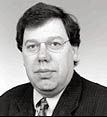 Brian Cowen
Brian Cowen took over as Irish Foreign Minister about two years ago from the well respected David Andrews, who retired from front line politics. Brian Cowen had a bullish reputation after his stint as Minister For Health but such a reputation wouldn't work in the political hot house that is Northern Ireland. The big decisions in Northern Ireland and reviews and talks were usually chaired at Downing Street by Bertie Ahern and Tony Blair but when they were called elsewhere Brian Cowen and Northern secretary Dr. John Reid took over. His influence in the North is still quite negligble although his predecessor had a large and vital role in the GFA negotiations and the subsequent abolishion of Articles 2 and 3 from the Irish constitution.
He has a good working relationship with Dr. Reid, with some Unionists including David Ervine and with Nationalists. He has been busy with Ireland's UN Security Council Presidency but if the going gets tough again up North he's the man to have in there.
| Creation of N.I. | Unionist | Nationalist | Non Aligned | British Govt. | American Influence |