
|
|
 British Government
BRITISH GOVERNMENT
The British government's attitude to Northern Ireland has changed considerably over the past 80 years, its gone from apathy to patriotic to apathy again. Since the inception of Northern Ireland various British governments have failed to make a real, workable policy for an inclusive Northern Ireland until recently. The government's role in Northern Ireland has always been a controversial one.
The actual partition of Ireland itself was the first of many controversial steps taken by the British government in Northern Ireland. The establishing of the parliament their was also full of controversy when James Craig, first NI Prime Minister, declared that this was a "Protestant parliament for a Protestant people". British inaction and basic apathy led to Nationalist unrest at biased legislation that the Stormont government passed and the gerrymandering of elections meant that Nationalist representation in parliament was always kept down.
During the troubles and when the IRA was at their height the government changed their strategy and tried to fight the IRA on a level playing field, setting up traps for them but unfortunately many innocent civilians, mostly Nationalist, got caught up in the violence. These British troops were very rough with innocent civilians which culminated in the Bloody Sunday masacre.
When Margaret Thatcher took over as Prime Minister relations between the British government and the Nationalist community worsen. Her stance over the IRA hunger strikes was one of not an inch and made her the most hated woman in the Republican community. Her objections to IRA prisoners being treated as prisoners of war was iterated in her statement that "crime is crime is crime". Her stance did gain some support in the Republic with Fine Gael's Garret FitzGearld and Irish Labour party member Conor Cruise-O'Brien both supporting her position. Her stance on this led to the election of Sinn Fein's first MP, Bobby Sands, who died just days later.
Just like the Irish governments position went from Republican to Centre thus the British governments position changed from Unionist to closer to centre under Thatcher's successor John Major. However in the commons he relied on the support of Ulster Unionist MPs so the initial progress that was made was stalled some what which led to the IRA breaking their ceasefire. When Tony Blair took over the British government moved completely to the centre which greatly helped the negotiations leading to the Good Friday Agreement. In fact its almost gone full circle as now Unionists are protesting that Sinn Fein are being given too many concessions like prisoner releases and being given offices at Westminster.
Perhaps in some regards there right the Unionist community have given a lot to this process and Sinn Fein just seem to be recieving and recieving. But in fairness to the present British administration they've greatly improved in their attitudes towards Nationalists and thus helped create the platform for reform.
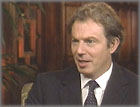 Tony Blair
At different times of his Premiership Tony Blair has been hated by nationalists and detested by Unionists, that probably shows how diplomatic and neutral Tony Blair can be. He's a man who seems to think that both Britain and the Irish Republic should have minimal influence in day to day Northern Ireland affairs and indeed only enters the arena when the process is in real trouble. He believes that Northern Ireland's problems should be sorted out by the Northerners themselves unlike previous PM's such as Jon Major and more infamously Margaret Thatcher.
Whenever Tony Blair talks on Northern Ireland he tries to be very diplomatic being very careful never to take one side or the other and always puts the best spin on any move. Unionists, especially the hardliners, view him as a "nationalist appeaser" as he has allowed Sinn Fein to take offices at Westminster and supported the stance of letting Sinn Fein into government before IRA arms were decomissioned.
I believe when it comes to Northern Ireland Tony Blair is the best man to hold the office of PM, more progress has been made under his premiership than any previous PM. He can work well with all sides and has a very good working relationship with the Taoiseach (Irish PM) Bertie Ahern. He's very adept at cutting deals and is not afraid to compromise. His persisent "concessions" to nationalists may undermine Unionist support for the Agreement but in the long run Westminster offices for SF won't be a major issue. On Northern Ireland one would have to give Tony Blair the tumbs up!
 John Reid
Before taking the post as Northern Ireland's Secretary of State Dr. John Reid admitted his knowledge of Northern affairs was minimal and he took over the post from Peter Mandelson at a very difficult time for the process. However John Reid has performed very well in this postition, being much more even handed than Peter Mandelson, who had absolutely no clue of the Nationalist community "the present symbol of the RUC perfectly encompasses both communities...it has the harp, shamrock and above it the crown..". Dr. Reid is in the same mould of Tony Blair but without the pretention. He tries to be very diplomatic but is not afraid to make the tough decisions when needed to like when he ended the LVF and UDA/UFF's ceasefires. He has also come in from criticism from both sides but more recently from the DUP for his decisions surrounding the election of David Trimble and Mark Durkan as First and Deputy First minister.
As long as Labour stay in power in Britain chances are John Reid will be kept on as Northern secretary. He hasn't caused much contoversy and despite what Unionists may feel he is pretty fair.
| Creation of N.I. | Unionist | Nationalist | Non Aligned | Irish Govt | American Influence |